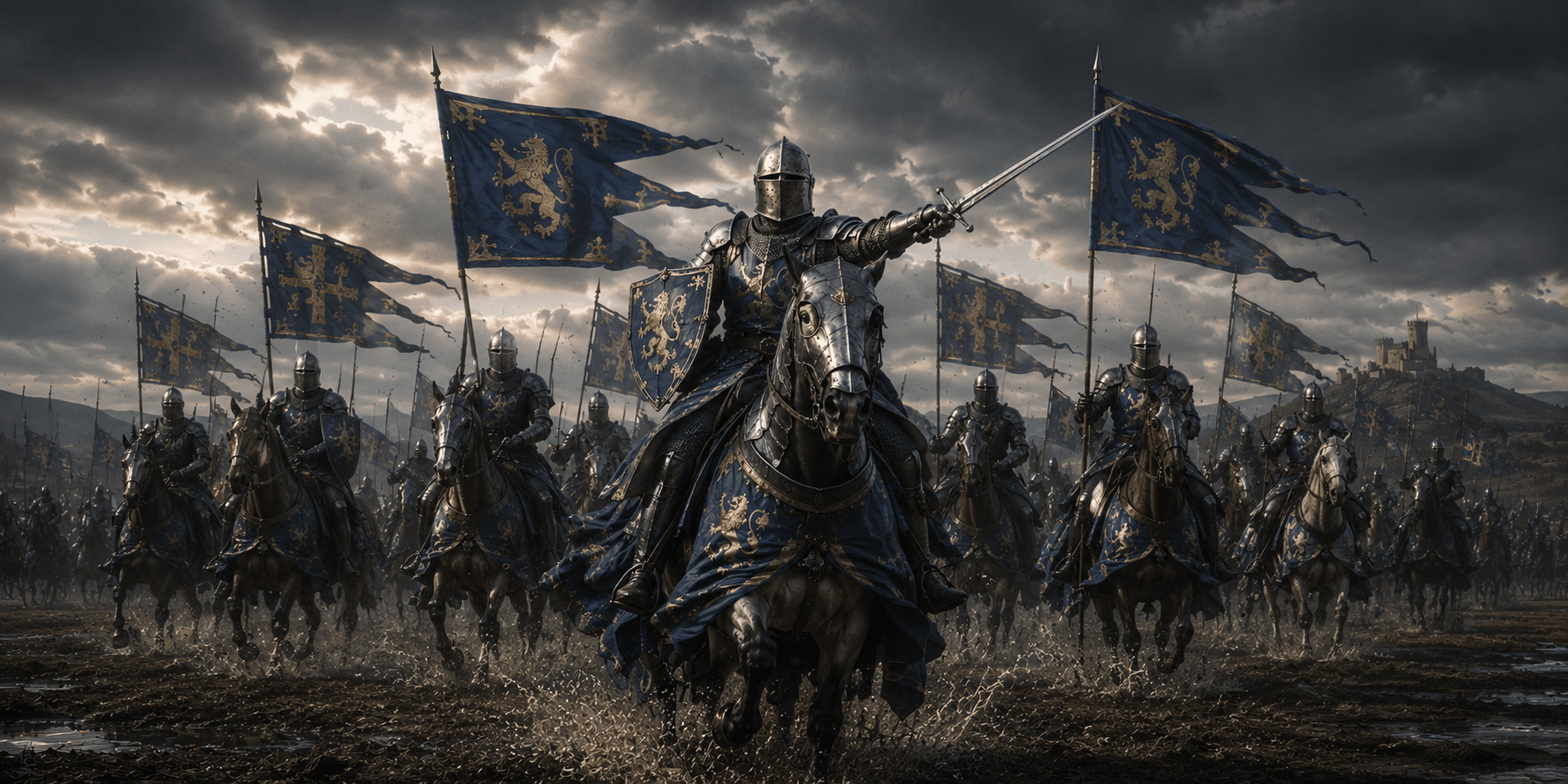
Of Knights and Men
We celebrated our eldest grandson’s fifth birthday last weekend. His Narnia-themed party featured small wooden-sword party favors. He is all about swords and armor these days. Nothing delights him more than a toy weapon, and if there isn’t one at hand, a stick will suffice. On a recent walk in the park, in fact, he collected sticks all day and cried when his daddy wouldn’t let him take his “broadswords” home to add to his armory.
After the Narnia party, when he would ordinarily have been napping, his grandaddy and I collected him and took him on a special birthday outing to our local museum, which was hosting a traveling collection of medieval armor and weaponry from the Stibbert Museum in Florence, Italy. When we pulled into the parking lot and he glimpsed the enormous poster of a knight in full armor that spanned the height of the museum building, his delight erupted into every exclamation a five-year-old could muster.
These exclamations continued inside as he dragged me from display to display, periodically explaining with raised eyebrows, “These are real swords, Grandmommy. These are real crossbows. This was a real boy’s armor, Grandmommy. This is real.”
At one point, he explained that he preferred this helmet over that one because it was a “real Calormene helmet.”
“A what helmet?” I asked.
“A Calormene helmet, Grandmommy, like in The Horse and His Boy,” he replied, with the tone of, “What’s the matter with you that you don’t remember the Calormenes?”
Meanwhile, I too have been spending time among knights and heroes of old, not in Narnia, but in Idylls of the King. Tennyson’s epic verse adaptations of the Arthurian legends offer a profound meditation on the nobility and weakness of man. Here, stories of duty – to king, lover, or brother – all turn on the limitations of character and knowledge that define the human experience, evoking pathos with every turned page. As I read, I note a great gulf between those legendary figures and modern man. Why are ideals like duty and honor, nobility of heart, fidelity, piety, and courtesy so hard to find these days? Instead, we seem ever plagued by the very weaknesses that undid Camelot: vanity, pride, haste, infidelity, deceit, jealousy, lust, and the thirst for power.
Perhaps these shared weaknesses actually unite us. Every man – whether of the Round Table, the Narnian royalty, or the modern age – lives in quest of what Timothy Keller called, “the good and better”: the good and better King, the good and better Father, the good and better Brother, the good and better Son, the good and better Lover, the good and better Man. Maybe that’s why these stories captivate us. They project a true image of man, in all his grandeur and misery, that resonates across the vast expanse of time and culture. They call virtue out of our hearts even as they bemoan our lack thereof, voicing with pathos our longing for the good and better Warrior, who, as the Anglo-Saxon Pearl Poet imagined, climbed up the rood to rescue His tribe from death and win glory for them forever.
Last Saturday, at the Museum of Arts and Culture, my grandson’s imaginary world of knights and legends met with the “real” world of iron swords and steel helmets. Those displays substantiated Narnia in his heart better than any movie adaptation, fixing its protagonists, thrust despite their weaknesses into heroic roles, like steel in his little soul. I could see the flickerings of knighthood in his eyes: nobility, honor, duty, chivalry, loyalty, piety, valor. I would feed these small flames, now only licking at his heart, until they blaze into mature manhood. He will need them, as I do, in this real world.
And so, let knights and legends live! Let us feed on fairytales that make us ache with longing for the Good and Better. Give us Arthur and his worthies. Give us Narnia’s Peter and Edmund, Lucy and Susan. Give us stories that depict the real struggles of man, the real war that besets us – Calormenes and Narnians – fiction and faith, fighting for our fealty. May the Good and Better triumph in our hearts.