
Beating Out the Fire
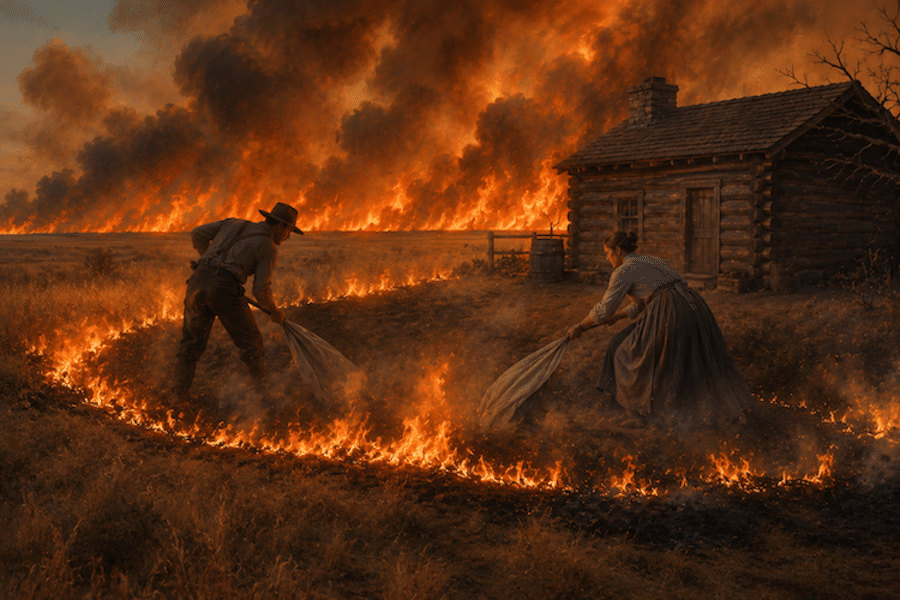
There is a chapter in Laura Ingalls Wilder’s Little House on the Prairie in which Ma and Pa fight a wildfire as it rages toward their house. Pa hurriedly digs a trench around the cabin and fills it with water while Ma wets flour sacks. He back burns toward the fire, preparing for its approach. Together, Pa and Ma stand inside the fire line, beating out sparks that jump the line, while Laura and Mary cower behind the corner of the house and Baby Carrie cries inside:
Pa’s little fire was all around the house now, and he helped Ma fight it with the wet sacks. The fire blew wildly, snatching at the dry grass inside the furrow. Pa and Ma thrashed at it with the sacks, when it got across the furrow they stamped it with their feet. They ran back and forth in the smoke, fighting that fire.
The prairie fire was roaring now, roaring louder and louder in the screaming wind. Great flames came roaring, flaring and twisting high. Twists of flame broke loose and came down on the wind to blaze up in the grasses far ahead of the roaring wall of fire. A red light came from the rolling black clouds of smoke overhead. (Chapter 22)
As a child, I read this passage in terror. I had watched the Ingalls stake everything on the frontier to carve a home out of the wild with their energy, love, and labor. My heart raced as I engaged with their furious efforts to protect it from flames that threatened to obliterate it in an instant. I never dreamt that I would ever find myself in similar circumstances. But this year has brought a particularly bad fire season to my Eastern Washington town.
When we built our place 28 years ago, we had never heard of fire season, and for the better part of our kids’ childhood, we never saw smoke, except for the controlled burns conducted on the reservation on the other side of our lake. Today, I play the refugee, evacuated by a wildfire that swept across my mountain neighborhood in minutes, devouring forests, homes, and everything else that stood in its path.
Adam and I were two hours distant when a neighbor called to see if we wanted him to rescue anything from our home. We hadn’t even received the evacuation notices yet. We broke all speed limits racing home to see what might be left, and I cannot communicate the enormous relief we felt when we arrived to see our home still standing in the meadow at the top of our hill, untouched.
I moved from room to room, taking this off a shelf and that off a wall, loading entire drawers of undigitized family photos into my car, packing for this trip I hadn’t planned. What would you take if you had only hours to save a few precious possessions from your home? My list was small. Photos of my children. Teaching notes. The journals I’ve kept since I was 12. Some necessary clothes and toiletries. Something to eat on a pilgrimage. I packed these bits and pieces of our family’s life into our car while Adam and some dear friends attempted to remove plants and pine needles from around the foundation of our home.
When news that our evacuation had been stayed to a watch and wait status, we slept in shifts, setting our alarm to regular intervals to venture near the fire lines and check its progress. We did this for two days.
Monday morning, waiting, I walked again through my house, choosing things to save. I called my six children, asking each what they wanted us to salvage. Their answers were compelling: If there’s time, save your love letters from Daddy. If there’s time, choose your favorite books from your library, especially the poetry you’ve annotated. If there’s time, save your notes from homeschooling. Save the cups you rescued from Great Grandma’s house before her fire. But most of all, please, please, save yourselves.
Piece by piece, I loaded my car. That little red rocker my great-grandfather made for my grandma when she was two. The sculpture of a ballerina my mother gave me for my high school graduation. The charcoal drawings my daughter did that hang in our hallway. The Keble College teapot that belonged to my favorite professor. Framed pages of Psalm 127 from the original King James Bible, a wedding gift from my in-laws: “Unless the Lord builds a house, they labor in vain who build it…”
But how do you pack a mural? Or the pencil marks on our mudroom wall that mark my children’s growing? Or the entire contents of my daughter’s apartment, parked in our attic while she is earning her master’s degree abroad? How do you pack up a life?
“Vanity, vanity, all is vanity saith the Preacher. It is vain for you to get up early and stay up late, to eat the bread of sorrow…” Are our possessions vain? Should we even try to save them? “They’re just things,” I thought. But they are things I have been given by people I love; each contains a story. They are things acquired with labor and industry. They represent time and effort. “By wisdom a house is built; by understanding it is established. By knowledge the rooms are filled with all precious and pleasant riches” (Proverbs 24:3-4).
I recall cantos 24 and 25 of Dante’s Inferno, in which thieves are damned to shift their shapes eternally in retribution for their trespass against what Martin Buber terms the “I-Thou” relationship. Although things cannot give us identity, our possessions become associated with us, extensions of the lives we live, the personalities we possess, the beauty we admire. Otherwise, why would we prize gifts from our forebears? Why museums? Why historians? Why that sense of violation in the face of theft?
We piled our things into our cars, watered our deck, set our sprinklers, and moved from the red zone to a local campground to wait. Meanwhile, the fire flanked toward our home and planes dropped water and retardant. For the next four days, we made regular visits to water the deck and do the little things we were told might make a big difference. Remove the air conditioners from the windows. Tape up the dryer vent. Rake under one more pine tree. That last needle might tell the tale. Talk about futility.
Thursday night, from our smoky campground, we watched a second fire across the Columbia River pick up speed and race 17 miles up the shore at breakneck pace like a beast on the prowl. Its glow reflected in the water and ash rained down on us as we sat, separated by half a mile of water, watching with horror.
The next morning, our grown son drove up from the city to beg us to remove ourselves from harm’s way and wait it out with the rest of the family. What could we do by staying nearby but endanger our lives and our health in the choking smoke? Though he made good sense, we could not help a feeling that we must stay nearby. Would leaving be failure? Would there be a home to return to if we left?
I recalled Pa and Ma with their carpets, dancing like wild men around their cabin, beating at the flames. I imagined my husband and myself, armed with nothing but a garden hose, standing at the top of our driveway, facing the demon fire I’d seen tearing across the darkening horizon. Ludicrous. Folly. Yet, something of the Ingalls’ pioneer spirit stirs in me.
Better sense prevailed, and we followed our son toward Spokane to wait it out, chiding ourselves for building our home in the forest. What were we thinking? But by noon Saturday, the Spokane Fire Complex had begun, and it dwarfed our local fire. By Sunday it had devoured more than 640 structures in the city and was being termed the largest disaster in the history of Washington state. Apparently, location isn’t our problem.
Whether in the city or at our private mountain retreat, there’s no getting away from reality. “In this world you will have trouble,” Jesus warned. Perhaps trouble exists to goad us toward His promised hope: “But take heart! I have overcome the world” (John 16:33). This present darkness starkly frames the light and life of His gospel.
I am finding that these present, painful circumstances are presenting rich opportunities to consider what really matters: the good life, the good love, the good death. I am sifting memories, asking questions — and I’m finding comfort amid anxiety, strength in dependency, and peace in surrender. I am learning to fix my eyes on what is eternal:
Blessed are they who dwell in Your house; they will be always praising You. Blessed is the one whose strength is in You, in whose heart are Your ways, who going through the valley of misery uses it for a well; indeed, the early rains fill the pools with water. They will go from strength to strength, and the God of gods shall be seen by them in Zion. (Ps. 84: 4-7)
I am drinking deeply from this well of misery.
Though we survived Saturday’s winds, our fire still burns uncontained, our home poised in the moment. I am not unique in this; I am surrounded by others facing loss.
May we draw strength from one another and from others who have gone before and recorded their experience, like Ma and Pa Ingall beating out the fire, or like the American poet Anne Bradstreet, who beat out her own loss in her “Verses Upon the Burning of Our House, July 10, 1666.” She should have the last word:
When by the ruins oft I past
My sorrowing eyes aside did cast
And here and there the places spy
Where oft I sate and long did lie.
Here stood that trunk, and there that chest,
There lay that store I counted best.
My pleasant things in ashes lie
And them behold no more shall I…
Then straight I ‘gin my heart to chide,
And did thy wealth on earth abide?
Didst fix thy hope on mould’ring dust?
The arm of flesh didst make thy trust?
Raise up thy thoughts above the sky
That dunghill mists away may fly.
Thou hast a house on high erect
Framed by that mighty Architect,
With glory richly furnished,
Stands permanent though this be fled.
It’s purchased and paid for too
By Him who hath enough to do.
A price so vast as is unknown,
Yet by His gift is made thine own;
There’s wealth enough, I need no more,
Farewell, my pelf, farewell, my store.
The world no longer let me love,
My hope and treasure lies above.



Thank you for your story.